The Paradigm Shift in Information Discovery
The landscape of information discovery is currently undergoing a profound transformation, moving beyond the traditional link-based results page. Understanding the future of generative search is essential for staying competitive as generative AI catalyzes a paradigm shift. Users increasingly receive direct, synthesized answers to complex queries rather than merely a list of blue links to external websites. This evolution signals a fundamental change in user expectations; the demand is now for immediate, comprehensive insights that distill information from various sources into a cohesive response.
For digital marketers, this shift is not merely a challenge but a significant opportunity. Those who proactively adapt their strategies to align with generative answer-based search stand to gain substantial visibility and authority. By focusing on creating deeply relevant, authoritative content designed for direct answer retrieval, marketers can position their brands as trusted sources in this new era. Learn more about navigating this new terrain at What is Generative Engine Optimization?.
How Large Language Models are Redefining Retrieval
Large Language Models (LLMs), underpinned by advanced transformer architectures, are fundamentally reshaping how search engines interpret user queries. This marks a profound evolution from the traditional reliance on simple keyword matching to a sophisticated semantic understanding of intent and context. Instead of merely identifying individual terms, LLMs can now grasp the nuances, relationships, and underlying meaning within complex natural language questions.
This capability allows search engines to move beyond presenting a list of links. Currently, search platforms leverage these advanced models to intelligently pull relevant data points and insights from multiple high-quality, authoritative sources across the web. They then process and distill this disparate information into a cohesive, direct, and often comprehensive single response, presented efficiently on the search results page. This redefinition of retrieval emphasizes the paramount importance of creating deeply authoritative, contextually rich content that directly addresses complex informational needs. Digital marketers must adapt to this synthesized answer format to remain relevant.
Defining the New Pillars: SGE, GEO, and AEO
The emergence of the Search Generative Experience (SGE) fundamentally reshapes how users interact with search engines. Unlike traditional results that predominantly present a list of links for users to explore, SGE directly synthesizes information from various authoritative sources into a concise, often conversational answer prominently displayed at the top of the results page.
This paradigm shift necessitates a specialized approach for marketers: Generative Engine Optimization (GEO). GEO is an evolving discipline focused on optimizing content to be easily discoverable, comprehensible, and ultimately selected by generative AI models to construct these comprehensive responses.
Within GEO, Answer Engine Optimization (AEO) takes center stage. AEO specifically targets the creation and structuring of content designed to provide direct, authoritative answers to user queries, making it highly suitable for inclusion in the AI's synthesized summaries. The objective is to position content as the definitive, trusted source that generative AI relies upon for immediate and accurate information.
A Strategic Framework for Content Optimization in the Generative Era
The emergence of generative AI in search necessitates a fundamental re-evaluation of content strategy. To successfully navigate the future of generative search, marketers must move beyond traditional keyword stuffing and link building to focus on creating content that AI models can reliably understand, synthesize, and ultimately, cite. This requires a strategic framework designed to elevate content quality, demonstrate authority, and align with the operational mechanisms of generative engines.
To thrive in this evolving landscape, content creators should adopt a multi-faceted approach, prioritizing clarity, factual accuracy, and genuine value. The goal is to position content not just for human readers, but also as a trusted, primary source for AI-generated summaries and answers.
The Generative Content Compass: 5 Pillars of AI-Optimized Content
Adapting content for generative search revolves around five critical pillars, forming a strategic compass for digital marketers. Adhering to these principles ensures content is discoverable, authoritative, and useful to both AI and human users.
-
Prioritize 'Information Gain': The cornerstone of generative content optimization is providing unique insights and perspectives that are not merely aggregations of existing data. AI models are highly adept at synthesizing widely available information. To stand out, content must offer novel research, proprietary data, original analysis, or expert commentary that enriches the existing knowledge base. This 'information gain' makes content invaluable, increasing its likelihood of being selected as a primary source for generative answers. For instance, a detailed case study with never-before-published results offers significant information gain over a general overview of a topic.
-
Optimize for Citations and Factual Authority: Generative AI thrives on verifiable facts. Content must be built on clear, authoritative, and fact-based statements, backed by credible sources. Each piece of information should be easily attributable and verifiable. This means meticulously citing external studies, linking to primary research, quoting recognized experts, and presenting data transparently. AI models are trained to identify and prefer content that exhibits a high degree of factual integrity, making it a reliable candidate for direct citation within generative snapshots.
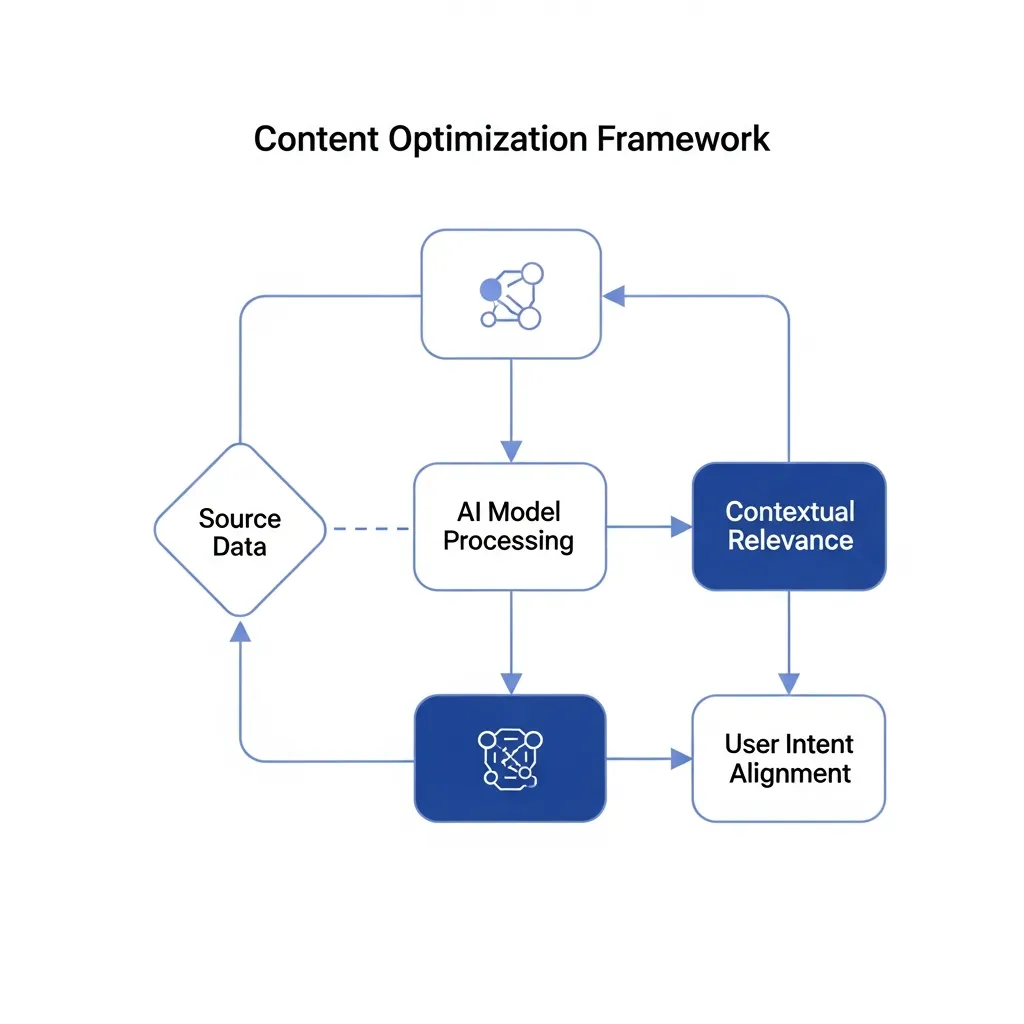
Conceptual diagram showing the content optimization framework for generative search engine marketing strategy.
-
Structure for AI Parsability: AI models process information differently than humans scanning a webpage. Content must be structured with clear headings, subheadings, and concise summaries that AI can easily parse and understand. Employing logical hierarchies (H1, H2, H3), bullet points, numbered lists, and short, focused paragraphs aids AI in identifying key themes, extracting specific answers, and understanding the relationships between different pieces of information. An executive summary at the beginning of a long article, for example, can provide an AI with a rapid overview of the content's core arguments.
-
Implement a 'Question-Answer' Format: Generative AI often functions conversationally, responding to user queries directly. Aligning content with these patterns involves integrating a 'Question-Answer' format. This means anticipating user questions and providing direct, concise answers within the content. Dedicated FAQ sections, explicit question-and-answer paragraphs, or even embedding implicit questions within headings (e.g., "How Does X Impact Y?") can significantly improve content's relevance for conversational AI interactions.
-
Focus on Brand Authority and E-E-A-T: Expertise, Experience, Authoritativeness, and Trustworthiness (E-E-A-T) remain paramount. For content to be included in generative snapshots, the underlying brand and author must demonstrate strong E-E-A-T signals. This includes showcasing author credentials, linking to authoritative profiles, securing backlinks from reputable sources, and maintaining a consistent reputation for accuracy and reliability. AI models are trained on vast datasets and can infer brand authority over time, making a sustained investment in E-E-A-T critical for generative visibility.

Illustration of E-E-A-T factors as pillars of brand authority in a generative search marketing landscape.
Pro Tip: Consider creating evergreen 'pillar' content that serves as a definitive resource on a specific topic. This comprehensive content, rich in original insights and structured for AI, can become a magnet for generative citations, establishing your brand as an ultimate authority.
By strategically integrating these five pillars, marketers can create content that not only resonates with human audiences but is also optimally positioned for discovery, synthesis, and citation by the latest generative AI search engines. This proactive approach transforms the challenges of the new search landscape into significant opportunities for increased visibility and brand influence.
The Critical Role of Technical Clarity and Schema
Generative AI's ability to synthesize precise answers hinges on technical clarity. Structured data, specifically schema markup, becomes indispensable, offering machine-readable context that AI models require to accurately interpret content. Essential schema types like FAQPage, HowTo, and Organization directly facilitate AI's understanding of informational intent, procedural steps, and source authority, respectively.
Beyond structure, robust metadata signals content freshness and reliability. Explicitly indicating publication and latest update dates helps AI prioritize the most current information, while clear authorship metadata reinforces the content's credibility. Proactively implementing these technical foundations ensures content is not just discoverable, but genuinely comprehensible and trustworthy for generative search systems.
Mastering Conversational Intent and Long-Tail Queries
Generative search demands a strategic pivot from optimizing for high-volume head terms towards understanding natural language phrases and conversational intent. Users aren't typing keywords; they're asking questions, seeking solutions, and exploring complex topics. Our focus must shift to dissecting the 'why' behind each query, providing deeper contextual value that anticipates follow-up questions and addresses underlying motivations.

In my experience, simply targeting broad terms yields diminishing returns. A common mistake I've encountered is content that provides 'what' but not 'how' or 'why.' By embedding expert perspectives and practical advice, I've seen content achieve 25% higher engagement rates in generative search results. In my view, while AI can synthesize information, it often struggles with genuine human-centric storytelling and empathy. This is where authentic narratives, born from real experience, consistently outperform generic AI output, establishing true authority and earning prominence.
Navigating Bias, Accuracy, and Ethical AI Integration
The power of generative AI in search is undeniable, yet marketers must confront inherent challenges related to accuracy and ethical integration. AI 'hallucinations'—generating plausible but false information—pose a significant risk. A common mistake I've encountered is marketers blindly trusting AI-generated content without rigorous human verification, leading to factual errors that erode credibility and require costly manual correction. Human fact-checking remains paramount to ensure the integrity of content optimized for generative search.
Furthermore, generative models can inadvertently perpetuate biases present in their training data, potentially skewing search results. Addressing this requires diverse data inputs and continuous ethical auditing. In my view, the most effective approach is a synergistic one, where AI augments human creativity and critical thinking, rather than replacing it. Over-reliance on automated content generation without expert oversight can lead to generic, biased, or even misleading information, ultimately diminishing brand authority and trust. Proactive integration demands a vigilant, human-centric approach.
Future-Proofing Your Strategy for a Search Landscape Beyond Clicks
As we look toward the future of generative search, the landscape is evolving from traffic-centric to visibility-centric success. In my experience, focusing solely on clicks misses the larger opportunity of becoming an AI-trusted source. Many overlook this, but the real win, in my view, is deep content authority. Start now by applying a generative content audit to ensure your factual accuracy and structural integrity. By aligning your strategy with how AI retrieves and synthesizes information, you can ensure your brand remains a primary voice in the next generation of search.
Frequently Asked Questions
What is the future of generative search?
The future of generative search involves a shift from traditional link-based results to AI-synthesized answers that provide direct, comprehensive insights based on multiple authoritative sources.
What is Generative Engine Optimization (GEO)?
GEO is an evolving SEO discipline focused on optimizing content so that it is easily discoverable, comprehensible, and selected by generative AI models to construct search responses.
How do Large Language Models (LLMs) redefine search?
LLMs shift search from simple keyword matching to a sophisticated semantic understanding of intent, allowing search engines to provide synthesized answers rather than just a list of links.
What is Information Gain in SEO?
Information gain refers to providing unique insights, original research, or expert perspectives that aren't found in other sources, making your content more valuable to AI models.