Giới thiệu
The digital information sphere is rapidly evolving, driven by the rise of artificial intelligence. Content creators and SEO specialists currently face a new frontier where traditional ranking factors alone are insufficient. AI-driven search experiences, characterized by generative overviews and zero-click results, demand a deeper understanding of how algorithms interpret and synthesize information.
The critical challenge lies in ensuring your valuable content is not just found, but truly understood by AI models to achieve optimal visibility. This guide provides actionable strategies for mastering content structure for AI, enabling your content to thrive in this new era. It will detail how to architect your content for maximum impact, ensuring it stands out in generative search results. For a comprehensive overview of advanced strategies, see Generative Engine Optimization techniques.
The Evolution of Information Retrieval in the Age of AI
The digital landscape of information retrieval is experiencing a profound paradigm shift. No longer solely reliant on rudimentary keyword matching, search engines now employ advanced AI to decipher user intent through sophisticated semantic understanding. These intelligent models are designed to meticulously extract, synthesize, and summarize vast amounts of web content, directly fueling the generative search results and critical zero-click overviews users encounter.
To achieve optimal visibility, content must be inherently machine-readable, allowing AI algorithms to efficiently process and interpret its core message. The challenge lies in achieving this without compromising the content's depth, nuance, and overall quality for human audiences. Balancing AI accessibility with compelling human value is paramount for an effective content strategy in this rapidly evolving digital era.
Beyond Keywords: Optimizing for Entities and Semantic Context
The shift in search requires moving beyond keywords to understanding entities. These are distinct, unambiguous concepts—people, places, organizations, or ideas—that AI models identify and use to build knowledge graphs. These graphs map complex relationships, allowing AI to grasp the true meaning and context of content, differentiating, for example, "Apple" the company from "apple" the fruit.
Establishing topical authority requires content to demonstrate a comprehensive understanding of a subject by thoroughly covering its core entities and related concepts. This involves weaving in semantically relevant terms and ideas that naturally branch out, signaling deep expertise and building a robust, interconnected information web for AI synthesis.
Adopting natural language that mirrors human conversation is essential. AI models, trained on vast human communication datasets, find naturally flowing content and varied phrasing much more digestible. Directly addressing user intent enables AI to accurately extract key information for generative summaries, thereby enhancing visibility in modern search environments.
Architecting the Page: A Blueprint for AI-Friendly Content
The transition to AI-driven search necessitates a strategic shift in how content structure for AI is implemented on the page. Beyond semantic relevance, the physical layout and formatting of information directly influence an AI model's ability to parse, understand, and synthesize content effectively. Creating a clear, predictable content architecture is paramount for maximizing visibility in generative search results and zero-click overviews.
The Hierarchical Foundation: Guiding AI with Headings
A logical H1-H4 hierarchy serves as a vital blueprint for both human readers and AI. The <h1> tag should precisely state the page's primary topic, while subsequent <h2>, <h3>, and <h4> tags segment the content into digestible, semantically related sub-sections. This structured approach clarifies the information flow, allowing AI models to quickly grasp the main arguments and supporting details. Properly nested headings demonstrate a comprehensive understanding of the topic, signaling to AI that the content is well-organized and authoritative. AI uses this hierarchy to identify key themes and their relationships, which is crucial for generating accurate summaries.
Prioritizing Information: The Inverted Pyramid Approach
Adopting the 'Inverted Pyramid' writing style is critical for AI-driven search. This journalistic principle dictates placing the most crucial information—the main answer or key takeaway—at the very beginning of a section or paragraph. Subsequent sentences then provide supporting details, context, and background. This ensures that even if an AI model only extracts the initial sentences for a snippet or overview, it captures the core message. For generative AI, which prioritizes conciseness and direct answers, front-loading critical information significantly increases the likelihood of your content being selected for prominent display.
Structured Data for AI Extraction: Tables and Lists
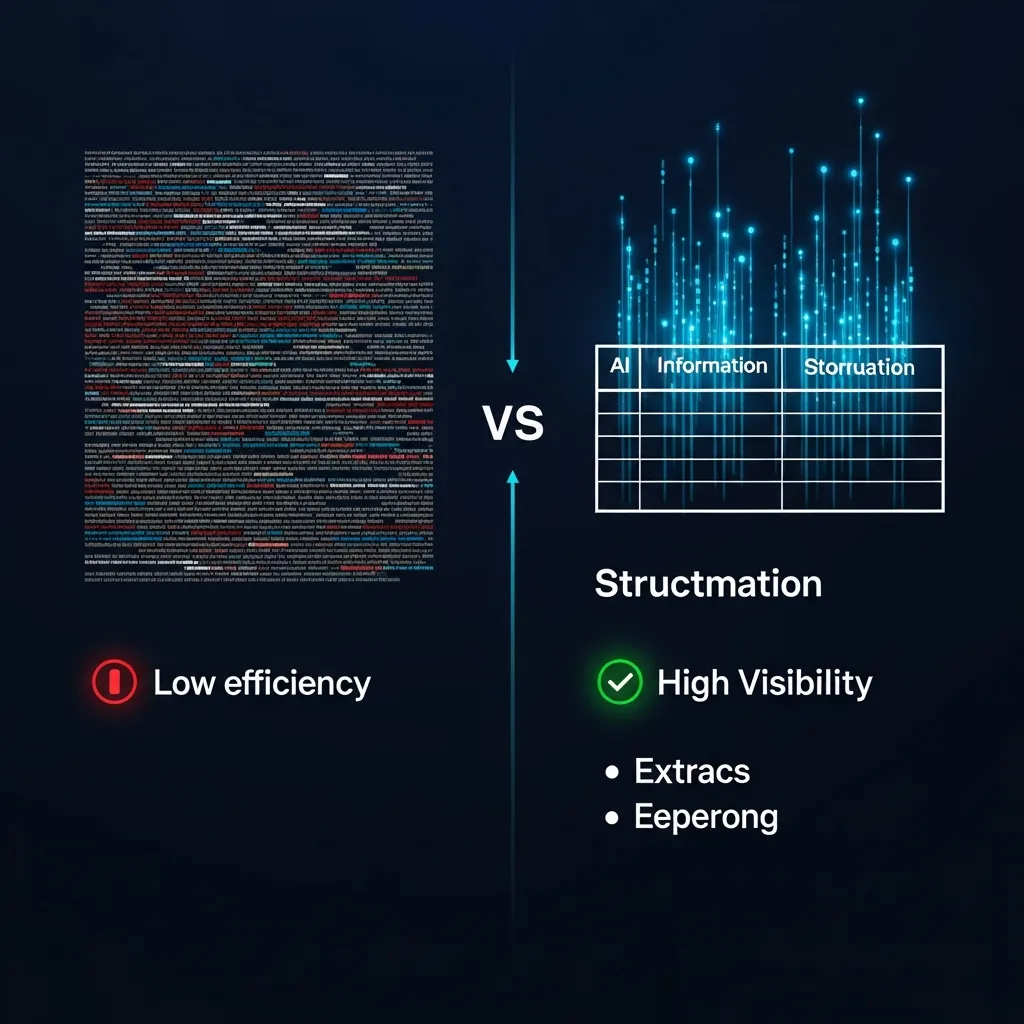
The strategic use of tables and bulleted lists dramatically enhances an AI's ability to extract specific data points and comparative information. Tables are ideal for presenting structured data, such as feature comparisons, specifications, or statistical breakdowns, making it effortless for AI to identify and present discrete pieces of information. Bulleted and numbered lists streamline complex processes, key benefits, or distinct characteristics, reducing cognitive load for both users and AI. These formats provide clear delimiters, allowing AI to parse information efficiently and present it in concise, actionable formats within overviews or direct answers.
Direct Answers for Instant Gratification: Definition Boxes
To capture zero-click results and feature prominently in AI overviews, explicitly crafting 'Definition Boxes' or dedicated sections for direct answers is invaluable. These are concise, self-contained paragraphs or formatted boxes that provide an immediate, unambiguous answer to a common question or a clear definition of a key term. For instance, a box titled "What is Semantic SEO?" followed by a precise, 40-60 word explanation. AI models are trained to identify and leverage such direct answers to fulfill immediate user intent without requiring a click-through, making these elements crucial for visibility.
Enhancing Visuals for AI Understanding: Multimedia Optimization
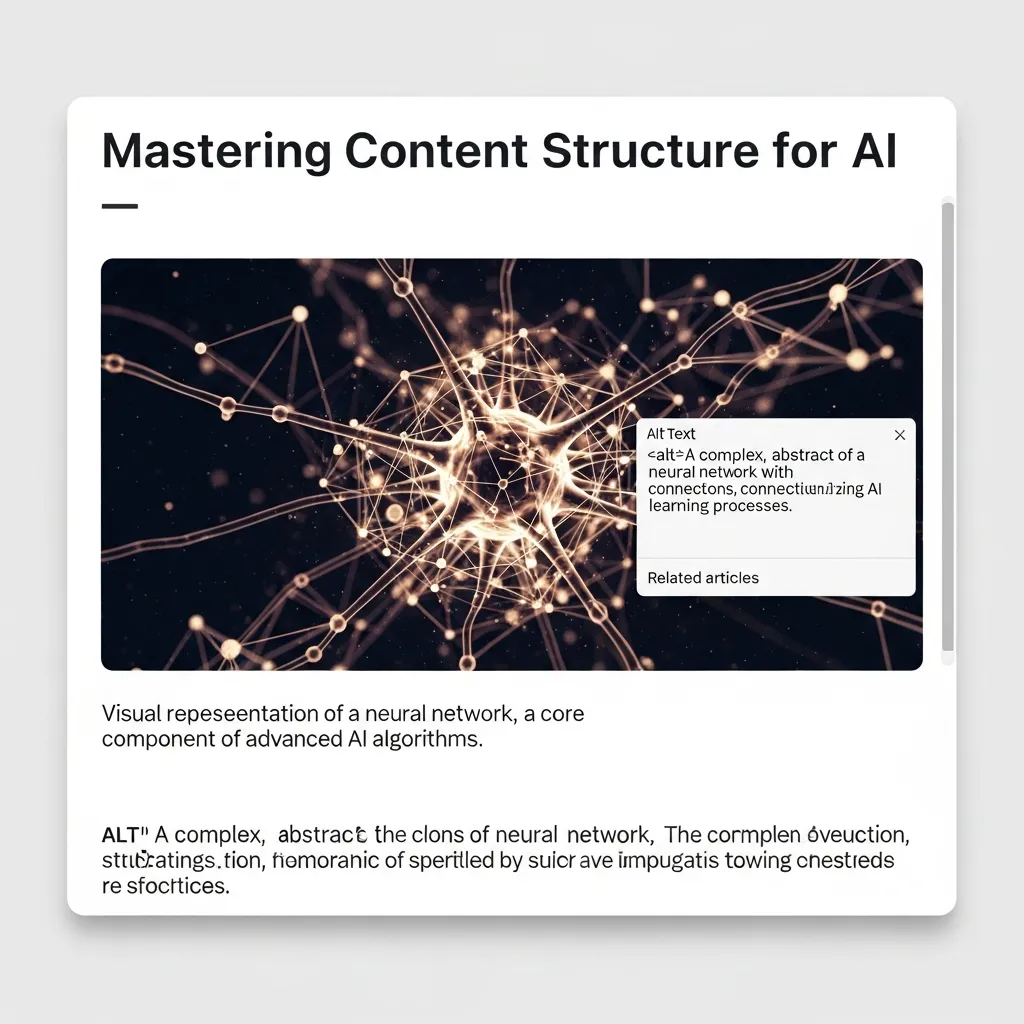
Multimedia, while visually engaging for humans, requires specific optimization to be fully understood by AI. Descriptive, context-rich metadata for images, videos, and audio files is non-negotiable. This includes detailed alt text that accurately describes the image content and its relevance to the surrounding text, descriptive file names (e.g., ai-content-structure-diagram.png instead of IMG_001.png), and informative captions. For videos, transcripts and structured data markup (like VideoObject schema) provide additional context. This metadata allows AI to understand the visual content, its context within the article, and how it contributes to the overall topic, enhancing content discoverability across various search modalities.
The AI-Friendly Content Architecture Blueprint
To ensure your content is optimally structured for generative search, adhere to this content structure for AI blueprint:
- Logical Heading Hierarchy: Implement
<h1>for the main topic, followed by<h2>,<h3>, and<h4>to segment and organize content logically. - Inverted Pyramid Writing: Place the most critical information at the beginning of sections and paragraphs.
- Structured Data Formats: Utilize tables for comparative data and bulleted/numbered lists for steps, features, or key points.
- Dedicated Answer Boxes: Create specific 'Definition Boxes' or direct answer sections for common questions and key terms.
- Comprehensive Multimedia Metadata: Provide descriptive
alt text, relevant file names, and informative captions for all visual elements.
By meticulously structuring your content according to these principles, you provide AI models with the clearest possible path to understanding, extracting, and presenting your valuable information.
Technical Foundations: Implementing Schema and Structured Data
While on-page content structure guides human readers and traditional crawlers, structured data markup provides AI models with an unambiguous interpretation of your content's meaning. Implementing schema is a vital communication layer, allowing generative AI to accurately parse, understand, and synthesize information for rich results, AI overviews, and direct answers.
JSON-LD is the preferred method for implementing structured data, embedded directly into your HTML to provide AI crawlers with machine-readable facts about entities and their connections. Selecting the appropriate schema type is paramount:
- Article schema is fundamental for informational content.
- FAQPage schema is indispensable for direct answers to common queries.
- HowTo schema clearly outlines steps for procedural content.
- Product schema enhances visibility for commercial pages.

Beyond individual content pieces, structured data enables deeper semantic connections. Properties like **SameAs** explicitly link an entity on your page (e.g., an author or organization) to its authoritative presence on platforms like Wikipedia. The **About** property clarifies your content's primary subject, helping AI models understand the core entity and its relation to broader web information. This explicit contextualization significantly boosts content discoverability and accuracy in AI-driven search.
The Synergy of Human Value and AI Accessibility
While optimizing content structure for AI is crucial, we must rigorously avoid over-optimization that alienates human readers. A common mistake is prioritizing AI parsing over human readability, resulting in overly rigid content that fails to build rapport. Instead, E-E-A-T signals should be integrated naturally. This means clearly showcasing expertise, authoritativeness, and trustworthiness through well-referenced claims and transparent author bios.
In my view, the most effective approach is to consider AI an advanced reader, not merely a crawler. AI models are trained on human-generated data and inherently value content that resonates with human users. Ultimately, high-quality, original insights remain the ultimate AI bait. Content offering unique perspectives, fresh data, or novel solutions—something only genuine human experience provides—will consistently stand out.
Critical Mistakes That Obscure Your Content from AI Models
Fragmented or thin content structures obscure your message; AI models struggle to synthesize value from disjointed information. A common mistake is content that superficially covers topics without providing true depth. Ignoring mobile-first indexing is another pitfall, as AI primarily crawls the mobile version, penalizing poor mobile experiences. Furthermore, relying on outdated tactics like keyword stuffing is particularly detrimental. This actively signals low quality to sophisticated AI models, potentially hindering visibility by 30-40% in generative search results.
Future-Proofing Your Strategy for Generative Search
Modern SEO's structural shift demands prioritizing semantic understanding and technical precision. In my experience, content with meticulous structured data sees significant generative search visibility gains. Embracing clarity and technical rigor is now non-negotiable for future-proofing. The evolving creator-AI relationship means AI amplifies well-structured human expertise, rather than supplanting it. Start now by applying a semantic clarity audit to your existing high-value content.
Kết luận
To succeed in the AI-driven search landscape, content creators must move beyond traditional SEO strategies. Focusing on a clear content structure for AI, optimizing for entities and semantic context, and implementing structured data is essential. This ensures that AI models can easily interpret and synthesize your information.
However, maintaining human value and E-E-A-T signals remains the key to standing out. By avoiding common mistakes and continuously refining your strategy to prioritize semantic clarity and technical precision, your content can achieve maximum visibility. Start evaluating and adjusting your content today to harness the full potential of the generative search era.
Frequently Asked Questions
What is content structure for AI?
Content structure for AI involves organizing information using clear hierarchies, semantic entities, and structured data (like JSON-LD) to help AI models easily parse and synthesize content for generative search.
Why is the inverted pyramid style important for AI SEO?
This style places the most critical information at the beginning of sections, making it easier for AI models to extract direct answers and summaries for zero-click results and generative overviews.
How does structured data improve visibility in AI search?
Structured data provides machine-readable context that removes ambiguity. It allows AI to identify specific entities and relationships, increasing the likelihood of appearing in rich results and AI-generated summaries.
What are definition boxes in content optimization?
Definition boxes are concise, formatted sections that provide immediate answers to common questions. They are highly effective for capturing zero-click positions in modern AI-driven search engines.