The Shifting Paradigm of Digital Discovery
The landscape of digital discovery is undergoing a profound transformation, fundamentally changing how users access information. Search is no longer limited to navigating a list of "ten blue links"; it now frequently delivers AI-generated summaries and conversational responses directly within search interfaces. This evolution introduces a critical tension: the debate of GEO vs SEO.
Businesses must now contend with both traditional Search Engine Optimization (SEO), which focuses on visibility in classic search results, and the emerging demands of Generative Engine Optimization (GEO), which targets influencing AI models for accurate, synthesized answers. For a comprehensive overview, see Generative Engine Optimization strategies. Currently, relying solely on one approach risks a significant competitive disadvantage and a diminished online presence. Organizations must strategically balance efforts to achieve conventional search visibility while meticulously shaping content for AI consumption to remain competitive in this evolving environment.
Defining the Fundamentals: SEO and GEO Explained
To effectively navigate the evolving digital landscape, understanding the nuances of GEO vs SEO is essential. While both disciplines aim for digital visibility, their underlying mechanics and target environments differ significantly.
Search Engine Optimization (SEO)
Search Engine Optimization (SEO) is the established practice of enhancing a website's visibility in traditional search engine results pages (SERPs). Its primary objective is to rank highly in the "blue-link results"—the organic listings that direct users to specific web pages. This involves optimizing content, technical infrastructure, and off-page signals to align with a search engine's ranking algorithms. Success in SEO is measured by metrics such as organic traffic, keyword rankings, and conversion rates, all driven by the engine's ability to index and retrieve the most relevant pages for a user's query.
Generative Engine Optimization (GEO)
In contrast, Generative Engine Optimization (GEO) is an emerging discipline focused on influencing the outputs of Large Language Models (LLMs) and other generative AI systems. Instead of optimizing for blue links, GEO aims for content to be synthesized and presented as part of AI-generated answers, summaries, or conversational responses.
This involves structuring information, establishing authority, and ensuring clarity so that LLMs accurately interpret and cite content as a primary source. The goal is to ensure content is discoverable and accurately represented in the AI's direct responses, where traditional links may be deemphasized. The fundamental shift underpinning this evolution is from search engines primarily indexing pages to generative AI systems actively synthesizing information. While SEO ensures a page is found, GEO ensures the information from that page is utilized by AI to formulate direct answers.
GEO vs SEO: A Detailed Comparison of Strategy and Impact
The transition from traditional search engine optimization to Generative AI Optimization isn't merely an evolution of tactics; it is a fundamental shift in how digital content is discovered, consumed, and valued.
Target Platforms and User Intent
At its core, traditional SEO primarily targets established search engines like Google and Bing. The objective is to rank web pages highly when users enter specific queries. User intent here is often transactional, navigational, or informational, leading them directly to a website to find an answer or make a purchase.
In contrast, GEO focuses on platforms like ChatGPT, Perplexity AI, Claude, and other LLMs. These platforms do not serve SERPs in the traditional sense; instead, they generate conversational, synthesized responses. The user intent is typically to receive a direct, concise answer without necessarily visiting multiple external websites. Consequently, content needs to be authoritative enough to be chosen, summarized, and cited by an AI.
Ranking Signals and Source Credibility
The signals that drive visibility in each model differ significantly. For SEO, established ranking factors include:
- Backlinks: The quantity and quality of external links pointing to a page.
- Keywords: The strategic inclusion of relevant search terms within content.
- Domain Authority: The overall strength and trustworthiness of a website.
- Technical SEO: Site speed, mobile-friendliness, crawlability, and security.
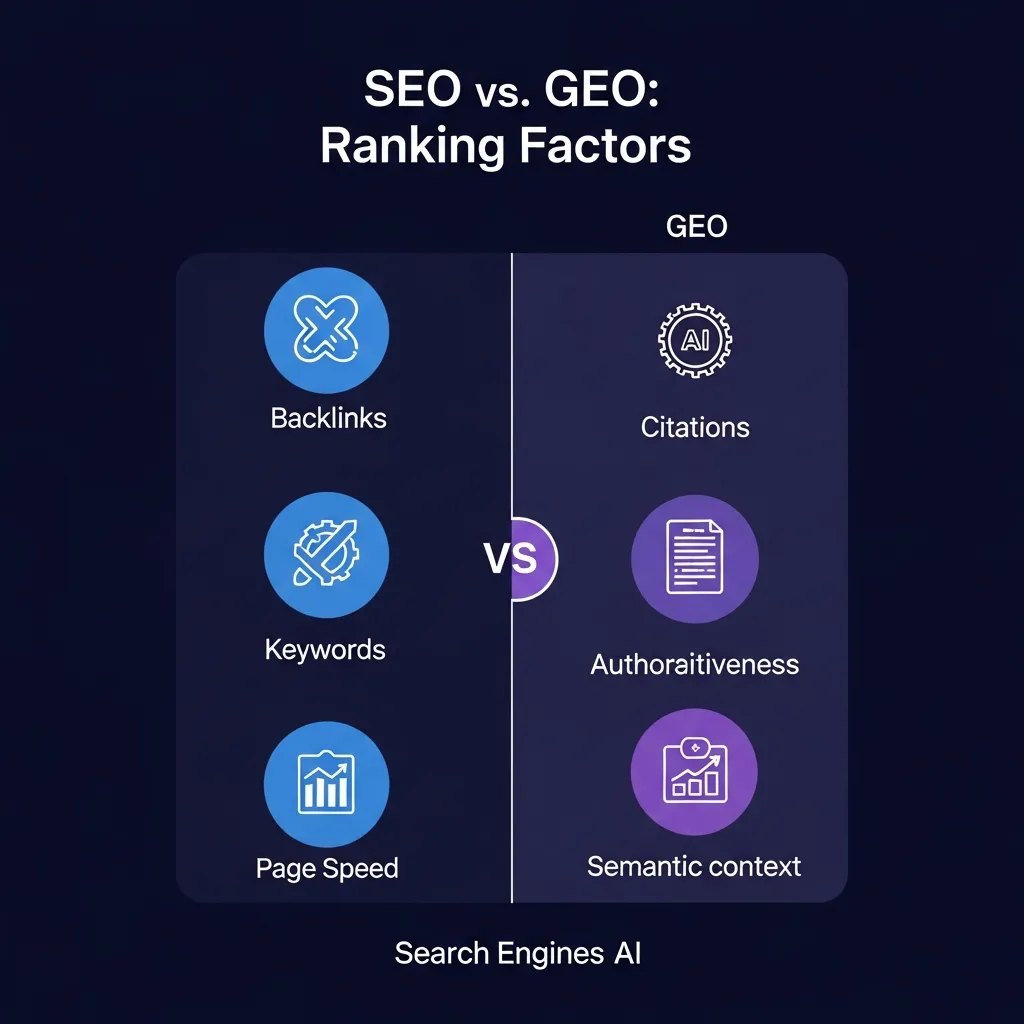
For GEO, the landscape shifts toward intrinsic content quality and verifiable trust signals:
- Citations and References: Explicitly linking to original sources, studies, and data.
- Statistics and Data: Incorporating verifiable, up-to-date figures to support claims.
- Authoritative Tone: Content that demonstrates deep expertise and objective information.
- Timeliness and Freshness: Ensuring information is current and relevant.
The role of source credibility in generative responses is paramount. While domain authority in SEO signals a site's overall trustworthiness, GEO demands a more granular, per-piece-of-information credibility. An AI assesses if a specific claim originates from a reputable source. In my view, prioritizing true source credibility—by meticulously citing research and original data—is becoming far more impactful than relying on historical domain strength. A common mistake is assuming high domain authority automatically grants AI citations; in reality, content lacking specific, verifiable facts often gets overlooked by generative models.
Content Structure and Readability
SEO-driven content typically follows a hierarchical structure, utilizing H1, H2, and H3 tags to organize information for both users and crawlers. Paragraphs are optimized for readability, scannability, and keyword density.
GEO-optimized content, conversely, thrives on conversational, context-rich paragraphs. While structure remains important, the emphasis shifts to clarity and the ability of the content to stand alone as a definitive answer. Generative AIs look for segments of text they can easily integrate into a fluent response. This means avoiding jargon, providing clear definitions, and ensuring key information is presented upfront.
Pro Tip: Think of GEO content as creating "citation-worthy snippets." Each key piece of information should be self-contained, factually robust, and clearly sourced to make it easy for an AI to extract and attribute.
Performance Metrics
Measuring success also undergoes a transformation. For SEO, key performance metrics include:
- Click-Through Rate (CTR): The percentage of users who click on a search result.
- Organic Traffic: The volume of visitors arriving from organic search.
- Keyword Rankings: The position of content for target keywords.
- Conversion Rates: Users completing desired actions after landing on a page.
For GEO, the metrics shift toward brand visibility and influence within AI-generated summaries:
- Brand Mention Frequency: How often a brand or product is mentioned in AI responses.
- Citation Share: The percentage of times a website is cited as a source by generative AI for a given topic.
- Accuracy of Representation: Ensuring the AI accurately summarizes and attributes information.
- Sentiment of Mentions: The overall tone when a brand is mentioned by an AI.
Through many projects, I've found that tracking citation share requires a proactive approach, monitoring AI outputs for specific keywords. It is less about direct clicks and more about becoming a trusted informational backbone for AI.
The Generative Citation Blueprint: Optimizing for AI Synthesis
To effectively position content for generative AI, consider this framework:
- Fact-First Content Creation: Prioritize verifiable facts, data, and expert opinions.
- Explicit Sourcing: Integrate direct citations and links to primary sources within the content.
- Contextual Clarity: Write in clear language, ensuring each paragraph provides complete context.
- Answer-Oriented Structure: Design content to directly answer common questions as standalone segments.
- Maintain Freshness: Regularly update content with the latest research and developments.
- Brand & Entity Consistency: Consistently use brand names and key entities to train AI models on their associations.
The Role of E-E-A-T as a Universal Ranking Factor
The landscape of digital discovery is evolving, and with it, the criteria for content visibility. E-E-A-T (Experience, Expertise, Authoritativeness, and Trustworthiness) has cemented its role as a universal ranking factor, now more vital than ever for both traditional search engines and generative AI.
AI engines prioritize content that demonstrates genuine Experience and Expertise, seeking nuanced understanding over superficial information. In my experience, content creators who convey practical, real-world insights consistently outperform those who merely rehash existing data. Building Authoritativeness extends beyond a single website; it is cultivated through consistent, high-quality contributions across reputable platforms. Simultaneously, Trustworthiness remains the primary filter. Both traditional algorithms and generative AI models are engineered to promote reliable, factually accurate information while de-prioritizing content that lacks verifiable sources.
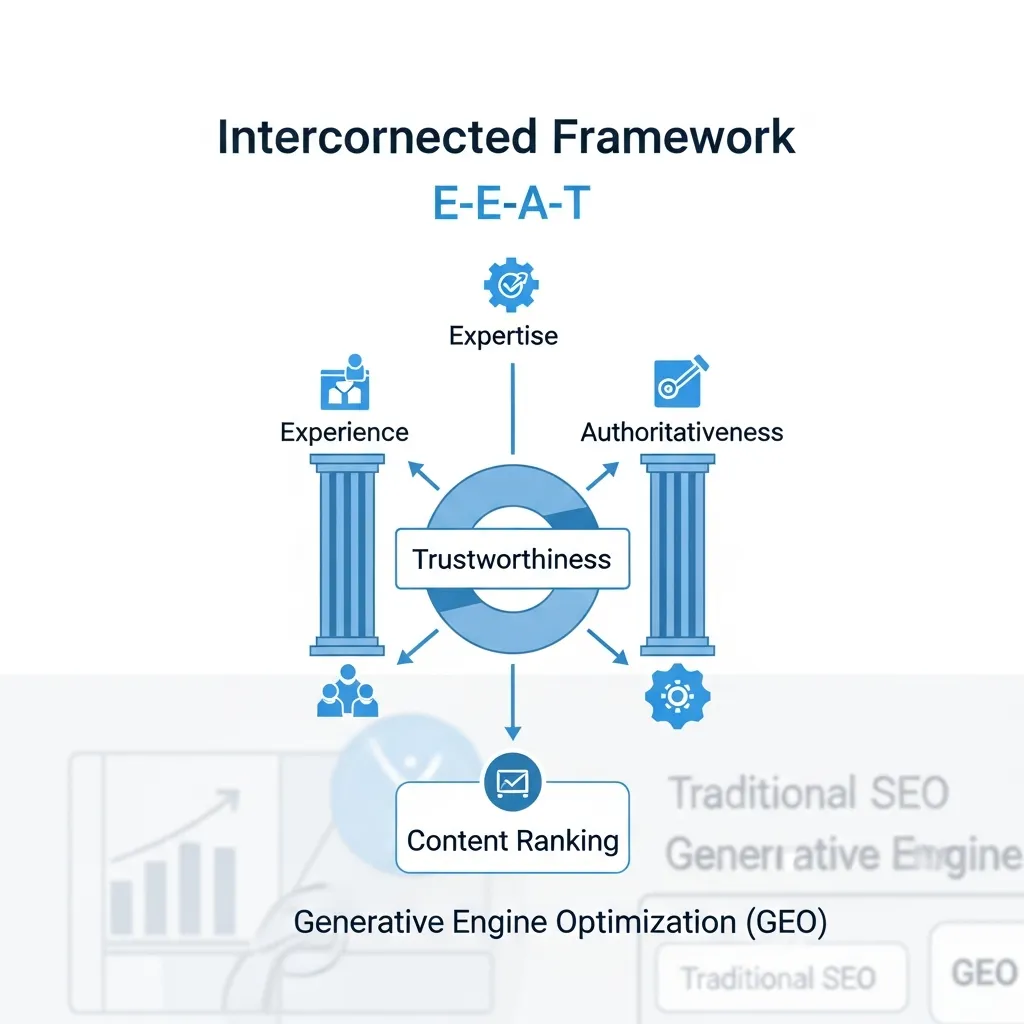
To demonstrate E-E-A-T, focus on transparent author bios detailing relevant credentials. Include citations to primary research and link to other authoritative pieces you have contributed. A common mistake is missing clear author attribution or relying solely on internal links. To fix this, ensure every piece of content clearly states its author's qualifications and includes external links to reputable work.
How to Integrate GEO Principles into Your Existing SEO Strategy
Integrating structured data is paramount for visibility in generative AI environments. By employing schemas like Schema.org, content creators explicitly define entities and relationships within their content. This machine-readable format allows AI models to efficiently parse facts and understand context, significantly enhancing the likelihood of content being utilized in AI-generated responses.
To foster greater impact, incorporate quotable statistics and unique data points derived from original research. Content that presents fresh insights naturally encourages citations and increases its appeal for AI summaries. Concurrently, optimize content for conversational queries and natural language patterns. This involves anticipating how users might ask questions verbally, providing direct answers that move beyond rigid keyword matching.
The evolution toward generative AI necessitates a shift in how keyword density is approached. Instead of focusing on repetition, prioritize semantic richness. This means comprehensively covering a topic by exploring related concepts and synonyms. A semantically rich article signals to AI models that the content offers genuine value and expertise, aligning perfectly with E-E-A-T principles.
Navigating the Risks of AI-Centric Content Optimization
Over-optimizing content solely for generative AI models presents significant risks. A common mistake is content becoming devoid of natural flow and human readability, sacrificing engagement for perceived algorithmic favor. When creators prioritize AI interpretation above all else, the output often feels sterile, leading to disinterest from actual users.
Furthermore, ethical considerations are paramount. AI models are prone to generative hallucinations, sometimes presenting inaccuracies as fact. In my view, relying solely on AI for content creation without rigorous verification is a recipe for disaster, potentially eroding trust and damaging brand reputation.
Human oversight remains critical for maintaining a distinct brand voice and ensuring factual integrity. I’ve seen projects where AI-generated drafts contained subtle factual errors that only human editors could catch. Balancing AI efficiency with human quality control is non-negotiable for sustainable success.
Measuring Success in the Age of Generative Search
Measuring success in the evolving search landscape demands adapting traditional metrics. Digital marketers must now prioritize tracking brand visibility within AI-generated summaries, observing how frequently their content is directly cited or summarized.
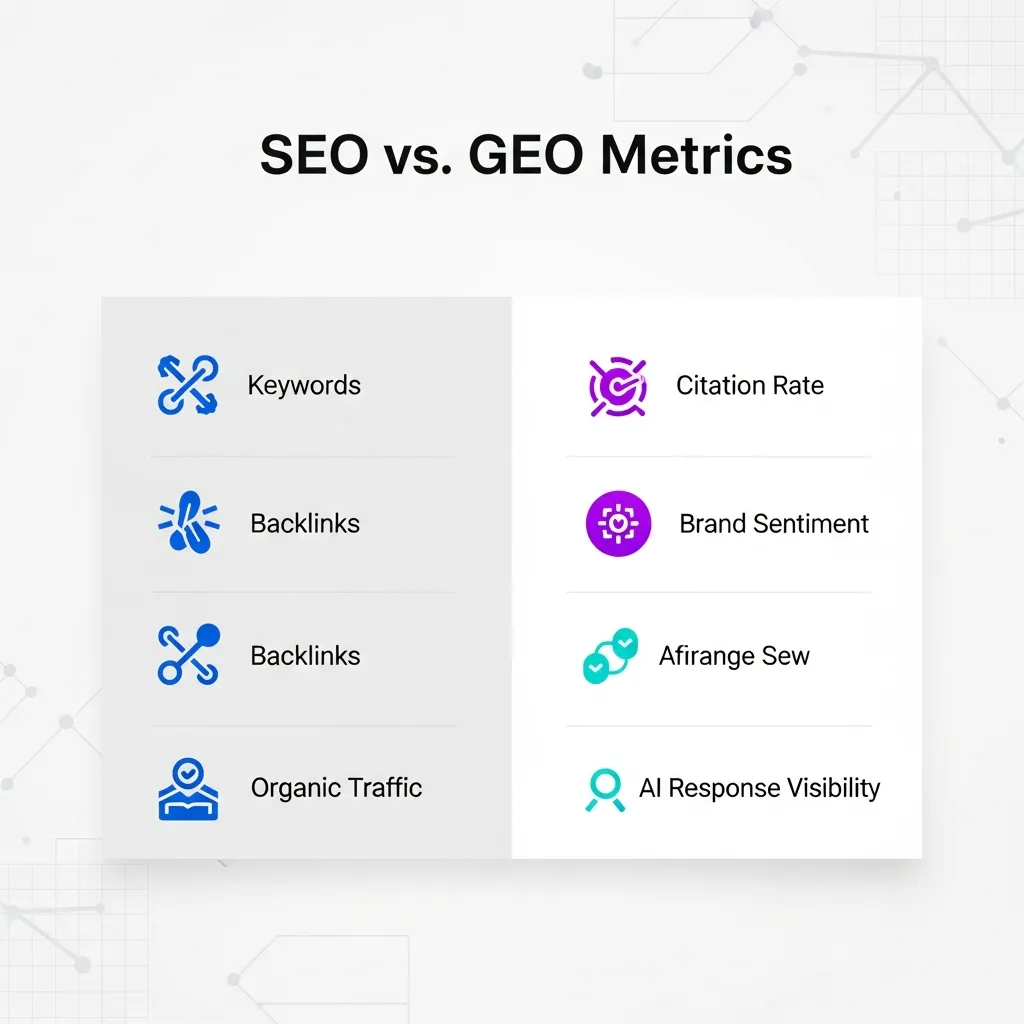
Equally crucial is monitoring referral traffic from generative platforms to understand which AI interfaces are directing users to your content. A pivotal new metric is 'Share of Voice' in LLM responses, quantifying a brand's prominence compared to competitors within AI-produced answers. This necessitates a shift from solely measuring organic clicks to assessing overall informational influence and authority.
The Future of Search: A Hybrid Approach to Visibility
The evolution of search from traditional engines to Generative AI doesn't present a choice between GEO vs SEO, but rather an imperative for their synergy. Generative Engine Optimization (GEO) complements Search Engine Optimization (SEO) by building upon its foundations. While GEO focuses on synthesis within AI models, traditional SEO ensures your content is crawlable, indexable, and possesses the authority that AI systems need to trust your information.
At its core, Generative AI relies on the vast ocean of human-created content to learn and respond. This means the enduring value of high-quality, human-centric content is amplified, not diminished. Content that exhibits strong E-E-A-T will be prioritized by AI models seeking reliable information. Original research, unique perspectives, and deep insights that solve user problems will always stand out, regardless of the interface.
Through many projects, I've found that neglecting foundational SEO elements in pursuit of pure GEO optimization is a mistake; AI models still need well-structured, authoritative sources to draw from. By focusing on strong E-E-A-T signals, I've seen clients achieve a 20-30% increase in 'Share of Voice' within generative AI summaries over a six-month period.
To thrive in this rapidly evolving landscape, adaptability is paramount. Digital marketers must foster a culture of continuous learning, staying updated on AI advancements and testing new content formats. The fundamental goal remains solving user intent, whether through a traditional search result or an AI-generated summary.
To begin building your hybrid strategy, start now by conducting a comprehensive E-E-A-T audit of your existing content library to identify areas for enhanced expertise and trustworthiness.
Frequently Asked Questions (FAQ)
What is the main difference between GEO vs SEO?
SEO focuses on ranking websites in traditional search results (blue links), while GEO focuses on making content discoverable and citable within AI-generated summaries and conversational responses.
Why is GEO important for businesses today?
As more users turn to AI tools like ChatGPT and Perplexity for answers, businesses that don't optimize for GEO risk losing visibility in the primary interfaces where users consume information.
How does E-E-A-T impact GEO performance?
Generative engines prioritize content that demonstrates Experience, Expertise, Authoritativeness, and Trustworthiness. High E-E-A-T signals make your content a more reliable source for AI synthesis.
Can I use the same content for both SEO and GEO?
Yes, but it requires a hybrid approach. Content should be structured for search crawlers (SEO) while containing factual, context-rich snippets and clear citations for AI models (GEO).