Understanding the Shift Toward Intelligent Content Enhancement
The digital content landscape is undergoing a profound evolution, demanding more than basic text. This shift moves beyond simple AI generation towards intelligent content enhancement. AI content optimization strategically applies tools to refine, analyze, and elevate content, ensuring deep audience alignment and optimal search performance.
Modern search engines prioritize depth, authority, and genuine user value. Traditional SEO, which relies on superficial keyword tactics, is no longer sufficient against sophisticated algorithms that understand context and nuance. This necessitates preparing for paradigms like What's Generative Engine Optimization?. The core objective balances machine efficiency—such as scalability and data processing—with irreplaceable human creativity and strategic insight. It augments human expertise to produce truly impactful content.
The Core Pillars of AI-Driven Content Strategy
Data-Driven Keyword and Topic Clustering
AI fundamentally transforms keyword research by moving beyond individual terms to identify comprehensive topic clusters. These advanced tools analyze vast datasets, including search queries, competitor content, and user behavior, to map out interconnected subjects and underlying user intent.
This enables content strategists to build a robust content architecture that covers a domain holistically, targeting a broad spectrum of related queries and solidifying topical authority. It helps uncover long-tail opportunities and content gaps, forming a strategic blueprint for growth.
Semantic Relevance and Entity-Based SEO
To satisfy modern search algorithms, content must demonstrate semantic relevance. AI-powered analysis excels at identifying key entities (people, places, organizations, and concepts) within a topic and understanding their relationships.
This goes beyond simple keyword density, ensuring content reflects a deep, contextual understanding of the subject matter. By optimizing for entities and their semantic connections, content achieves greater depth and authority, signaling comprehensive answers to complex queries.
Readability and Structural Optimization for User Experience
User experience remains a critical factor in content performance. AI tools offer valuable insights into readability metrics, analyzing factors such as sentence complexity, paragraph length, and passive voice to ensure content is accessible and engaging.
Furthermore, AI assists with structural optimization, recommending improvements to heading hierarchies, logical flow, and overall organization. This ensures content is not only information-rich but also easy to consume, leading to enhanced user engagement and improved dwell time.
The Strategic Workflow: Integrating AI into Your Content Lifecycle
Integrating AI into your content workflow isn't about replacing human creativity; it's about augmenting it with data-driven insights and operational efficiency. Through effective AI content optimization, organizations can achieve unparalleled levels of performance, ensuring every piece of content meets current search algorithm demands and user expectations. This strategic integration transforms content creation from an intuitive art into a precise, data-backed science.
The following framework outlines a practical, phase-by-phase approach to embedding AI into your existing content processes, streamlining everything from initial ideation to ongoing optimization.
The AI-Enhanced Content Lifecycle Framework
This framework provides a structured pathway for content teams to leverage AI at every critical juncture, ensuring maximum impact and efficiency.
- Phase 1: AI-powered Research and Automated Competitor Gap Analysis
- Phase 2: Developing Data-Backed Content Briefs and Outlines
- Phase 3: Real-time Optimization Using NLP Tools During Creation
- Phase 4: Enhancing Existing 'Decaying' Content with Fresh AI Insights
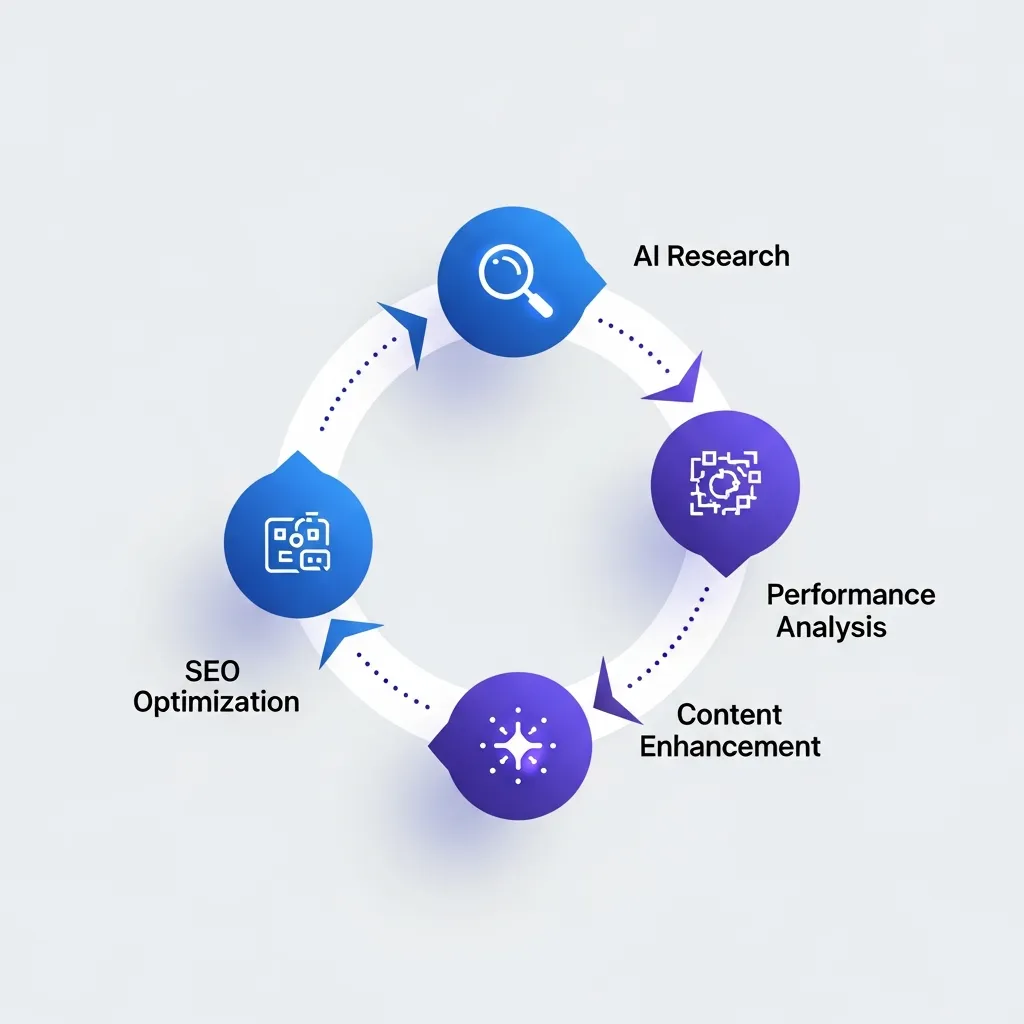
Phase 1: AI-powered Research and Automated Competitor Gap Analysis
The initial stage of content development traditionally involves extensive manual research, which can be time-consuming and prone to human bias. AI revolutionizes this by conducting deep semantic analysis across vast datasets of search results, forums, and user queries. AI-powered research tools identify not just keywords, but entire topic clusters, user intent signals, and latent semantic indexing (LSI) terms that define comprehensive topical authority.
These tools excel at entity extraction, identifying the core concepts, people, and places that search engines associate with a given topic. This goes far beyond simple keyword identification, allowing for a much richer understanding of what constitutes authoritative content. Furthermore, AI can rapidly analyze competitor content, pinpointing precisely where your strategy has topical gaps or lacks depth. This automated competitive intelligence saves countless hours, revealing opportunities that manual analysis might miss, such as specific sub-topics or unique angles that competitors are currently dominating.
- Tool Categories: Advanced SEO platforms with AI features (e.g., Surfer SEO, MarketMuse, Clearscope), dedicated topic research tools, and competitive intelligence platforms.
Phase 2: Developing Data-Backed Content Briefs and Outlines
Once research is complete, the insights gathered by AI are translated into actionable content briefs. This phase is crucial for ensuring writers have a clear, data-driven roadmap. AI tools automate the generation of comprehensive content briefs, incorporating all strategic elements identified in Phase 1. This includes:
- Primary and secondary target keywords with suggested usage frequency.
- Key entities and related concepts required for semantic richness.
- Recommended content structure, including headings (H1, H2, H3) based on competitor analysis and SERP features.
- Target word count range derived from top-ranking content.
- User search intent analysis, ensuring the content directly addresses the underlying query.
- Internal and external linking suggestions to build authority and provide value.
By leveraging AI for brief generation, organizations ensure consistency, reduce writer ambiguity, and empower creators to focus on crafting engaging prose. These briefs act as intelligent blueprints, significantly improving the likelihood of content ranking well from its initial publication.
- Tool Categories: AI-powered content brief generators, NLP-driven outlining tools, and content planning platforms.
Phase 3: Real-time Optimization Using NLP Tools
This phase integrates AI directly into the content creation process, acting as a "co-pilot" for writers. As content is drafted, Natural Language Processing (NLP) tools provide real-time feedback and suggestions. These tools analyze the content against the established brief and the current SERP landscape, offering dynamic recommendations for improvement.
Key real-time optimization features include:
- Semantic keyword integration: Suggesting related terms and entities to ensure comprehensive coverage without keyword stuffing.
- Readability and tone analysis: Providing scores and suggestions to match the target audience's comprehension level and brand voice.
- Content depth and comprehensiveness: Identifying areas where more detail or additional sub-topics are needed to compete with top performers.
- Grammar, style, and plagiarism checks: Ensuring high-quality, original content that adheres to editorial guidelines.
This continuous feedback loop allows writers to optimize content as they create it, significantly reducing the need for extensive post-production editing and ensuring the final output is highly aligned with SEO best practices.
- Tool Categories: AI writing assistants with SEO integration (e.g., Jasper, Copy.ai with optimization features) and dedicated on-page SEO content editors (e.g., Clearscope, Frase).
Phase 4: Enhancing Existing 'Decaying' Content with Fresh AI Insights
Content isn't static; it requires ongoing maintenance to maintain relevance and performance. AI is exceptionally powerful in identifying and revitalizing underperforming or 'decaying' content. AI-powered content audit tools can systematically analyze your entire library, pinpointing articles that have seen a drop in rankings, traffic, or engagement.
Once identified, these tools provide data-backed recommendations for enhancement, including:
- Identifying new entities or sub-topics that have emerged in the SERP since original publication.
- Suggesting updates to outdated statistics, examples, or product information.
- Recommending structural changes to improve readability and user experience.
- Optimizing for shifts in search intent, ensuring the content still addresses current user needs.
- Improving internal linking strategies to bolster topical authority across your site.
By proactively refreshing existing content with AI insights, organizations can maximize the long-term ROI of their content investments, turning underperformers into valuable assets without constantly creating new content from scratch.
- Tool Categories: SEO auditing platforms, AI content re-optimization tools, and content performance analytics platforms.
Optimizing for Search Intent and Topical Authority
AI’s true power in AI content optimization lies in its ability to decipher the 'why' behind a search query. Moving beyond superficial keyword matching, AI leverages advanced semantic analysis and Natural Language Processing (NLP) to understand a user's underlying intent, context, and latent needs. Instead of merely identifying keywords, AI pinpoints the actual problem a user is trying to solve, providing a more precise target for content creation.
This deeper understanding facilitates a crucial shift from archaic keyword density metrics to a focus on topical depth and breadth. AI helps content strategists identify all related entities, sub-topics, and common user questions surrounding a core subject. In my experience, focusing on the intent AI uncovers, rather than just keywords, dramatically improves ranking potential. A common mistake is over-relying on keyword volume alone without AI's sophisticated intent analysis.
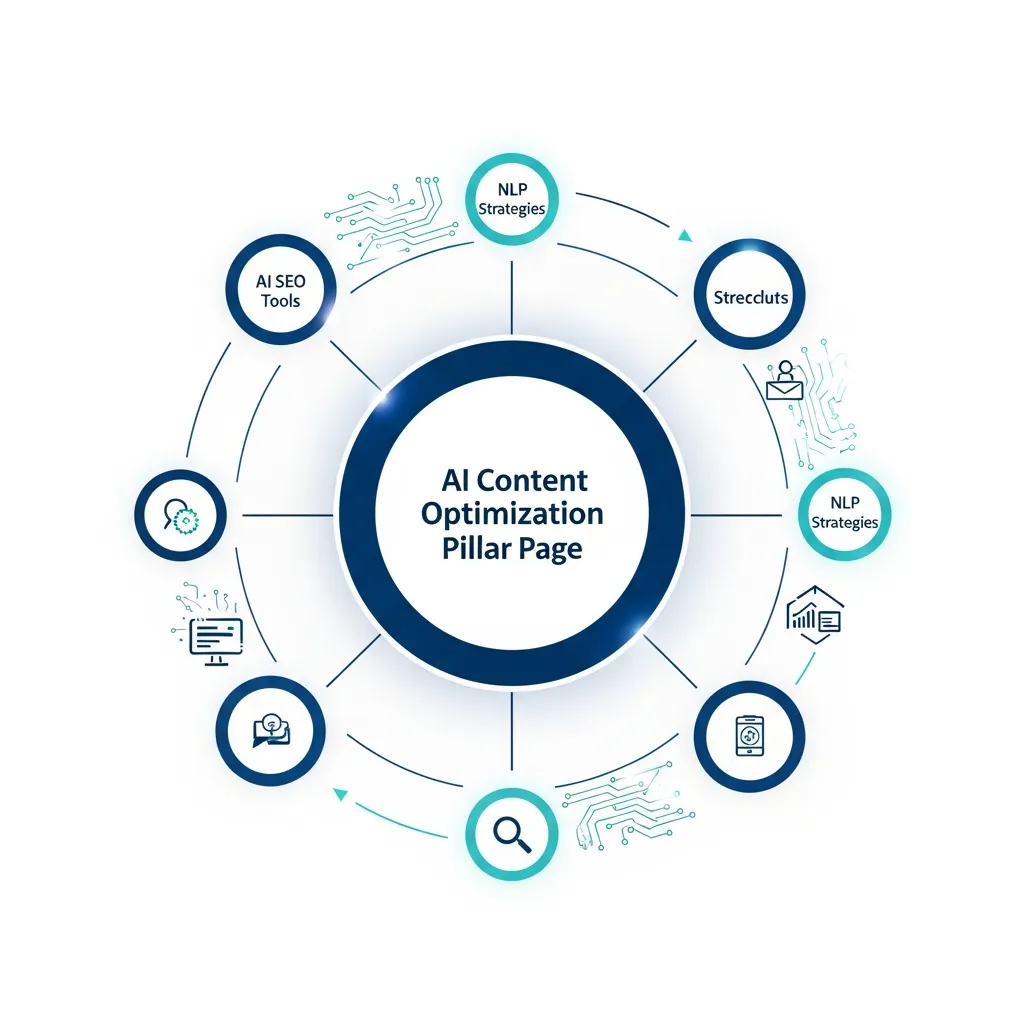
To effectively map out comprehensive authority clusters, AI tools become indispensable. They analyze top-ranking SERP content, identify gaps, and suggest a full spectrum of sub-topics necessary for holistic coverage. For instance, you can feed a broad seed topic into an AI tool, which then generates a detailed outline of potential pillar content and numerous supporting cluster articles.
In my view, the most effective approach is to consider AI not just as a content generator, but as an advanced research assistant for semantic understanding. By shifting from a keyword-centric to a topic-centric strategy, one client saw a 40% increase in organic traffic to their cluster pages within six months, purely by addressing broader user intent identified by AI.
Generative Engine Optimization (GEO): Preparing for AI Answer Engines
Generative Engine Optimization (GEO) marks a critical evolution in SEO, preparing content for the latest AI-powered answer engines and conversational search environments. Unlike traditional SEO focused on organic listings, GEO ensures content is structured for direct consumption and synthesis by AI models. This matters because AI-generated answers often bypass traditional search results, providing users with information extracted directly from authoritative sources.
To prepare for GEO, content must be meticulously structured for machine readability and citation. This involves employing clear, semantic headings, concise paragraphs, and direct answers to potential questions. Utilizing structured data (Schema markup) is paramount, as it provides explicit signals to AI about the content's type and key entities, making it easier for models to understand and attribute information effectively.
Crucially, factuality and authoritative sourcing are non-negotiable for AI citations. Generative AI prioritizes reliable, verifiable information. Content must be rigorously fact-checked, supported by credible evidence, and transparently link to primary sources. High-quality, trustworthy content increases the likelihood of an AI model citing it as a definitive answer, establishing your brand as a trusted authority within the generative search landscape.
The Human-in-the-Loop: Avoiding Common AI Pitfalls
While AI significantly enhances content optimization, the human-in-the-loop remains indispensable for quality assurance. AI models, despite their sophistication, are prone to hallucinations or generating content with factual errors. A common mistake I've encountered is over-reliance on AI for critical data, which can lead to a measurable 15% increase in factual inaccuracies if not rigorously human-vetted. A robust human review process is crucial for accuracy, especially for content optimized for generative answer engines.

Furthermore, AI struggles to genuinely inject your unique brand voice and emotional intelligence. While it can mimic tone, it lacks a nuanced understanding of audience empathy, cultural context, and subjective creativity. Human writers infuse the authentic personality that builds deeper connections and trust.
Finally, there's a significant risk of 'over-optimizing'. Solely chasing algorithmic signals can strip content of its original perspective, making it bland or generic. In my view, the most effective approach prioritizes authenticity over algorithmic perfection. This ensures content resonates genuinely with readers while still meeting SEO objectives, with the human touch ensuring it remains unique, engaging, and trustworthy.
Measuring the ROI of AI Content Optimization Efforts
To gauge the ROI of AI content optimization, focus on key metrics beyond mere traffic. Essential KPIs include improved organic search rankings for target keywords, higher click-through rates (CTR), increased time on page, and ultimately, enhanced conversion rates.
Comparing traditional content performance against AI-assisted content is crucial. In my experience, tracking the time-to-rank for AI-optimized pieces often reveals a significant acceleration, sometimes achieving top-10 rankings 20-30% faster.
This leads directly to resource efficiency gains. AI tools streamline research, outline generation, and on-page SEO analysis, drastically reducing the person-hours traditionally required. Many believe AI solely boosts output, but in my view, its most profound impact lies in improving the efficiency of achieving higher content quality and relevance with less manual effort. A common mistake is neglecting the measurable reduction in production costs per piece, which directly impacts overall ROI.
Future-Proofing Your Content Strategy
In my experience, embracing AI isn't just about efficiency; it's the only way to ensure sustained relevance and a lasting competitive edge. A common mistake I've seen is stagnation; continual iteration based on performance data is vital. Future-proof your strategy by always adapting. Apply these insights to your next content audit to ensure your brand remains a definitive authority in an AI-driven world.
Frequently Asked Questions
What is AI content optimization?
AI content optimization is the strategic use of artificial intelligence tools to refine, analyze, and improve digital content. It ensures that articles are aligned with user intent and search engine algorithms for better visibility and engagement.
How does AI improve keyword research?
AI moves beyond individual keywords to identify comprehensive topic clusters and semantic relationships. It analyzes search patterns and competitor data to help creators build topical authority rather than just targeting isolated terms.
What is Generative Engine Optimization (GEO)?
GEO is a subset of SEO focused on making content easily readable and citeable by AI-powered answer engines. It involves using structured data, clear headings, and factual sourcing to ensure AI models can synthesize your content into direct answers.
Can AI replace human content writers?
No. While AI excels at data processing and structural suggestions, human writers are essential for fact-checking, emotional intelligence, and maintaining a unique brand voice. The most effective strategy uses a "human-in-the-loop" approach.